Port x Mason & Fifth resident, Mofiyinfoluwa “Mo’” Okupe, attends Next Generation, a dance performance by Acosta Danza Yunior at Sadler’s Wells. Marvelled by the struggle portrayed by the dancers, Mo’ reflects on the longing for homelands and the ways in which the stage her page is but another example of the dance floor.

It is unbearably hot the afternoon I make my way to Sadler’s Wells East to see Next Generation; a performance by Acosta Danza Yunior, a Cuban dance academy. As I walk out of the Stratford station, the heat settles on my shoulders like a presence. This kind of sun always makes me think of home; Lagos with its humidity and heat, with its colours and sounds, with movement etched into the very DNA of the city and its people. We are never still. Can one be still on a piece of land surrounded by water; an ever moving entity that carries seen and unseen things across thousands and thousands of miles? Islands – like Lagos, like Cuba where Carlos Acosta’s Dance Academy have flown from to perform in London – are sworn to movement, migration, occupation, desertion. Conduits and vessels. Ships and shores. ‘Explorers’ and escapees.
This very tension is what ‘Fuga’ – the opening sequence of Next Generation begins with. Six dancers are confined to an illuminated square in the middle of the stage. Their bodies are flat on the ground when the sound of ocean waves begins to travel through the room. A young woman rises first, her gaze fixed far beyond; reaching for a thing she cannot even see. Her neck is elegant but strained, so much effort to see beyond. As the ocean waves give way to drums and quickened paces, we begin to see a whirlwind of movement. Another young man runs to the edge of the enclosure, his legs pointed perfectly, ready to bypass the boundary as the group pull him back in, refusing his departure. Another dances jumps, his entire body riveting with power as though he too were trying to escape. As a duet begins, the dancers pair up and play a tug of war; leave, stay, let me go, release me, hold on to me, set me free. Their bodies are like poetry in the flesh, splits perfectly offered, fingers delicately poised. Their brief moments of synchronisation are hypnotic, before they break apart again. One by one, they escape the enclosure, until only one dancer is left. The music mellows and darkness descends.
Watching them, my mind travelled to the thousands of families that are fractured by borders, by distance and visas, by migration and immigration, by forces greater than them. As I watched the dancers reach for each other, bodies taught with feeling and tension, I ached with the truth that we will always long for our lands, for our peoples, for the places we call home. We will long and that longing will somehow – heavy with its pain and blood and suffering – become art.
&
Before the performance started, I sat with one of the dancers; the young woman who was the first to rise from the enclosure in ‘Fuga,’ the first to look out to the horizon. Heidy Nuñez is a 16-year-old dancer who has been dancing for all of her life. She flew in with the rest of the Acosta Danza Yunior company from Cuba after joining them about eight months ago. She sits across from me, a gentle glow rising from her enamel smooth face. Her hair is tied back in a loose bun, a reddish-brown colour that catches the warm yellow light in the room. Dainty gold jewellery adorns her wrist and fingers. She is wearing black but there is something strikingly colourful about her presence. A pink seashell sits at the base of her neck. When I ask her what dancing and the stage means to her, a serious look comes over her face as she starts to speak:
“For me, dance means my life. I’ve been dancing since I was five years old. I have never imagined a day in my life without dancing or stretching. Even when I’m on vacation. And the stage is…everything. It is where I feel completely free.”

Listening to her speak, I think of the page and the freedom it offers me. The way it also feels like my life, like the thing I cannot live without. As practitioners of art, in any form, it is striking how much our souls intertwine with what we create; the subsumption of self that occurs, regardless.
Our discussion moves to the performance itself, Next Generation primarily explores youth and movement in Cuba. She laughs as she recalls the noisyness of the streets she called home; the outdoor parties, the vibrant colours, the grandmother or aunty always shouting your name, the ocean waves you only hear at the edge of the city. Cuba is a place alive with a multitude of sounds that call the body forth into movement. It sounds exactly like Lagos and we share a look when I say this; a look of home, of longing, of belonging. The first sequence of the dance, ‘Fuga,’ literally translates to ‘escape’ in English and while I watched the dancers only a few moments later, I understood even more what she shared. Cubans as a people have a long and complicated relationship with movement; with exile and escape, borders and breakings, the shore and the ocean. I am one of the thousands of Nigerians scattered across the globe in the great Exodus that has occurred over the last few years as the country we call home descended further and further into financial and infrastructural turmoil. For writers like me, we make sense of this on the page. And for dances like Heidy, and the entire Next Generation troupe, they make sense of it on the page.
&
The next two sequences of Next Generation are duets. In Caprioccio, the stage brightens to reveal two lovers whose faces are covered by a cloth that binds them together. It takes inspiration from one of René Magritte’s most famous series of paintings, The Lovers. The dancers are lithe and buoyant. The music quickens like a pulse and as I watch them I wonder at the naked intimacy of their movements, how it seems like their bodies are spilling vulnerabilities too heavy for words.
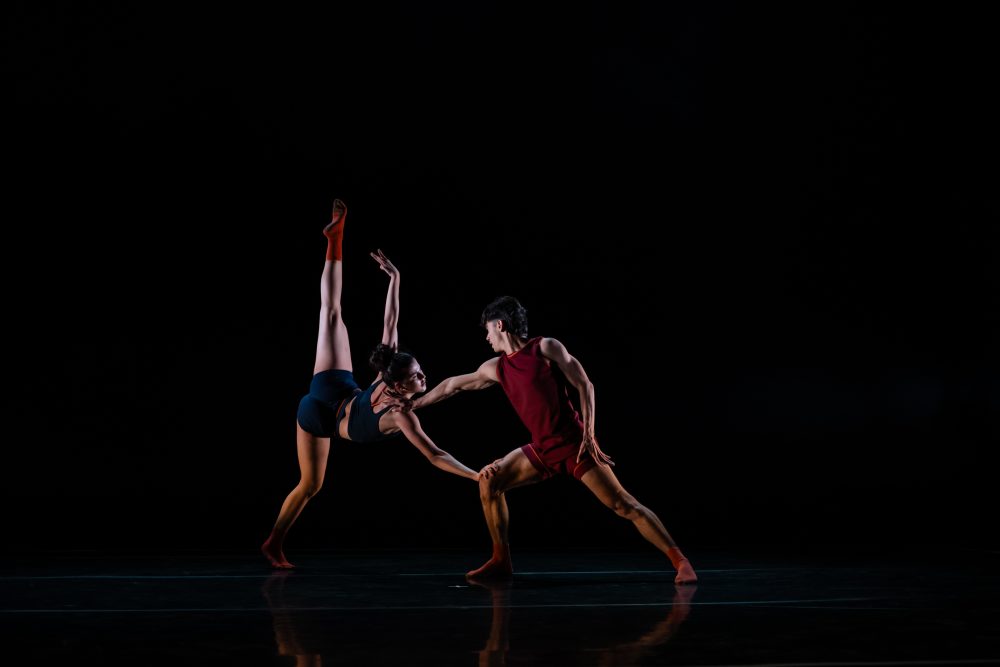
In the other duet, I think of migration and lovers; of bodies stretched in waiting, voices crackling through poor networks, caresses becoming forgotten memories in the ache of silence. When I ask Heidy how it feels to be so far from home because of her art, she tells me:
“The music asks me for more. It asks me to give everything.”
Just like the page. My desire to become a writer has carried me thousands of miles from my home. But dance as an artform is completely different from writing for its sheer use of the body. When I write it is the words on the page that become art, but for dancers like Heidy it is their very bodies that become the offering. It is their hands and feet, their faces, their entire physical entity is transformed into art. They translate feeling into motion. So where as I can write about what it feels like for your art to take you around the world while an invisible thread tethers you home, Heidy’s body reveals that same phenomenon through itself. Her body, her art becomes a place of revelation and truth. I cannot take my eyes off them.
&
The final sequence of Next Generation, ‘Interpretation of The World’ is the most hypnotic of them all. The darkness lifts to reveal water lilies hanging delicately from the ceiling. White petals beaming in the dark. They are an installation by Cuban visual artist Glenda León which creates an ethereal feeling on the stage. In Cuban culture, according to Heidy, water lilies symbolise the strength of being rooted, whilst still blooming. The entire ensemble is here again and there is a striking uniformity and seamlessness with which they move. Earlier, Heidy told me the group had a rule:
“If the group moves together, we will make it. Yes, we have to be ourselves and we have to look out for ourselves, but the group is always first. We have to be there if something fails and you have to be there for whoever needs it. You have to shine as yourself, but you have to make the group shine as well.”

And shine they do. The ocean waves from ‘Fuga’ come back again and it feels like the dancers have allowed themselves to be carried by the tides. Watching them I think of the splendour of community and union, of togetherness and belonging. There is so much reliance on each other’s bodies as they move, one dancer’s arm is the core centre of another’s movement. They hoist each other up, their fluidity creating unbridled beauty. It must take such a toll on their frames. When I asked Heidy the most difficult part of being a dancer, she replied without even thinking for a moment; “The bruises.” From slamming into the floor multiple times in a day in endless rehearsals, to falling and slipping. She continues,
“There is pain in the art. You get hurt in the process of finding the right sense of movement. You don’t dance with a mirror in front of you. So you have to know your body and while you’re dancing, you need to know if you’re doing good, if the step is well executed. You have to know when it feels right to yourself and you keep repeating until you hit that moment. It’s like when you’re off balance and you have to know how to get it back. That’s why you have to repeat it again and again. And that’s why it’s a good thing to fail because you get to know how to recover from it. You get to find the right moment.”
I’m struck by the wisdom of her response; by the wisdom her craft has shown her. To be so young and be blessed with the knowledge that failure is useful, that it can be a compass that leads you toward truth. The beauty of Next Generation is not just a shallow, aesthetic offering, but something deep and true; unearthed from the pain, trials, resilience and survival of a people. As only real art can do, it opens a tender and honest portal into the lives of a people and invites us in to see a light that we can turn on our own selves and our own journeys to find a sliver of truth, to see ourselves more clearly.